Colorado HB 22-1355 | Packaging that Gets Noticed
Colorado EPR Law: The Complete Guide for Packaging Producers
Colorado’s producer dues have been live since January 2026 — this isn’t a law to prepare for anymore, it’s one to be compliant with today. This page breaks down who’s covered, what’s required, and what it costs, plus a free calculator to estimate your obligation..
- Trusted by 12 brands navigating packaging compliance
- 7 states with EPR laws — Colorado fees have been live since January 2026
- HB 22-1355 signed into law 2022
Current Legal Status
Updated August 2026
Colorado is one of only two states — alongside Oregon — where packaging EPR fees are actually being invoiced today. Producer responsibility dues went live in January 2026, and the 2025 Annual Supply Report was due to Circular Action Alliance on May 31, 2026. If your business sells into Colorado and hasn’t registered, this isn’t a future deadline — it’s a live gap with sales-restriction exposure right now.
Important: Since July 1, 2025, producers may not legally sell or distribute covered materials in Colorado unless they’re participating in the program — through Circular Action Alliance or an approved independent program plan. There is no grace period built into that restriction.
2022
Year Colorado’s HB 22-1355 was signed into law
January
2026
Producer responsibility dues went live
$5.6M+ /
1 ton
Small producer exemption thresholds (CPI-adjusted annually)
Circular Action Alliance
Colorado’s designated PRO
Up to $20,000 + $6,000/day
Escalating penalties for repeat violations
What Is Colorado's HB 22-1355?
Colorado’s Producer Responsibility Program for Statewide Recycling Act (HB 22-1355), signed by Governor Polis in 2022, moves the cost of recycling packaging and paper products off local governments and residents and onto the businesses that put those materials on the Colorado market. Colorado was the third state to pass a law like this, after Maine and Oregon — and now the second, after Oregon, to actually start collecting fees.
The goal isn’t complicated: free, convenient recycling access for every Coloradan, funded by producers instead of taxpayers, with a statewide list of what’s actually recyclable so the guessing game ends.
"Why it exists":
- Recycling access and quality have varied wildly block to block across Colorado, funded inconsistently by local governments and ratepayers.
- HB 22-1355 creates one statewide collection list and a producer-funded system to build out the infrastructure to support it, at no added cost to residents.
- A bonus-malus eco-modulation structure rewards producers for recyclable design and penalizes materials that gum up the recycling stream.
Why Paper Wins Under HB 22-1355
Colorado’s fee structure applies automatic maluses to materials that disrupt recycling or fall outside the state’s Minimum Recyclable List, and rewards materials with high recycling rates and credits for in-state recycled content, clear labeling, and certified compostability. Paper tubes check those boxes by design — FSC certified, compostable, biodegradable — before eco-modulation even gets applied.
This is not a footnote to your compliance math — it’s a real lever on your Colorado dues. One tube at a time, we’re planting trees through our One Tree Planted partnership on top of it.
Are You a “Producer” Under Colorado's EPR Law?
If your business makes, sells, imports, distributes, or prints packaging materials or paper products sold into Colorado, you may be a “covered producer” — even if you don’t manufacture the packaging yourself.
Covered materials include:
- Packaging materials — paper, plastic, glass, metal, cartons, flexible foam, rigid packaging, food service ware, or combinations of these — intended for single or short-term use in containing, protecting, handling, or delivering products to consumers
- Paper products — printing paper, newspapers, brochures, booklets, catalogs, flyers, and magazines
Who counts as the "producer"?
- The brand owner of the product sold in packaging in Colorado
- If there’s no Colorado brand owner, the entity that manufactures, first imports, first distributes, or prints the covered material
Who's exempt?
- Businesses with less than roughly $5.6M in global gross revenue (the statutory $5M base, CPI-adjusted by CDPHE each July 1) OR under 1 metric ton of covered material supplied into Colorado per year — either condition alone qualifies
- Business-to-business packaging is explicitly exempt
- Note: exemption thresholds move every year — reconfirm your status annually rather than assuming last year’s number still applies
If your business makes, sells, imports, distributes, or prints packaging or paper products sold into Colorado, you may be a “covered producer” — even if you don’t manufacture the packaging yourself.
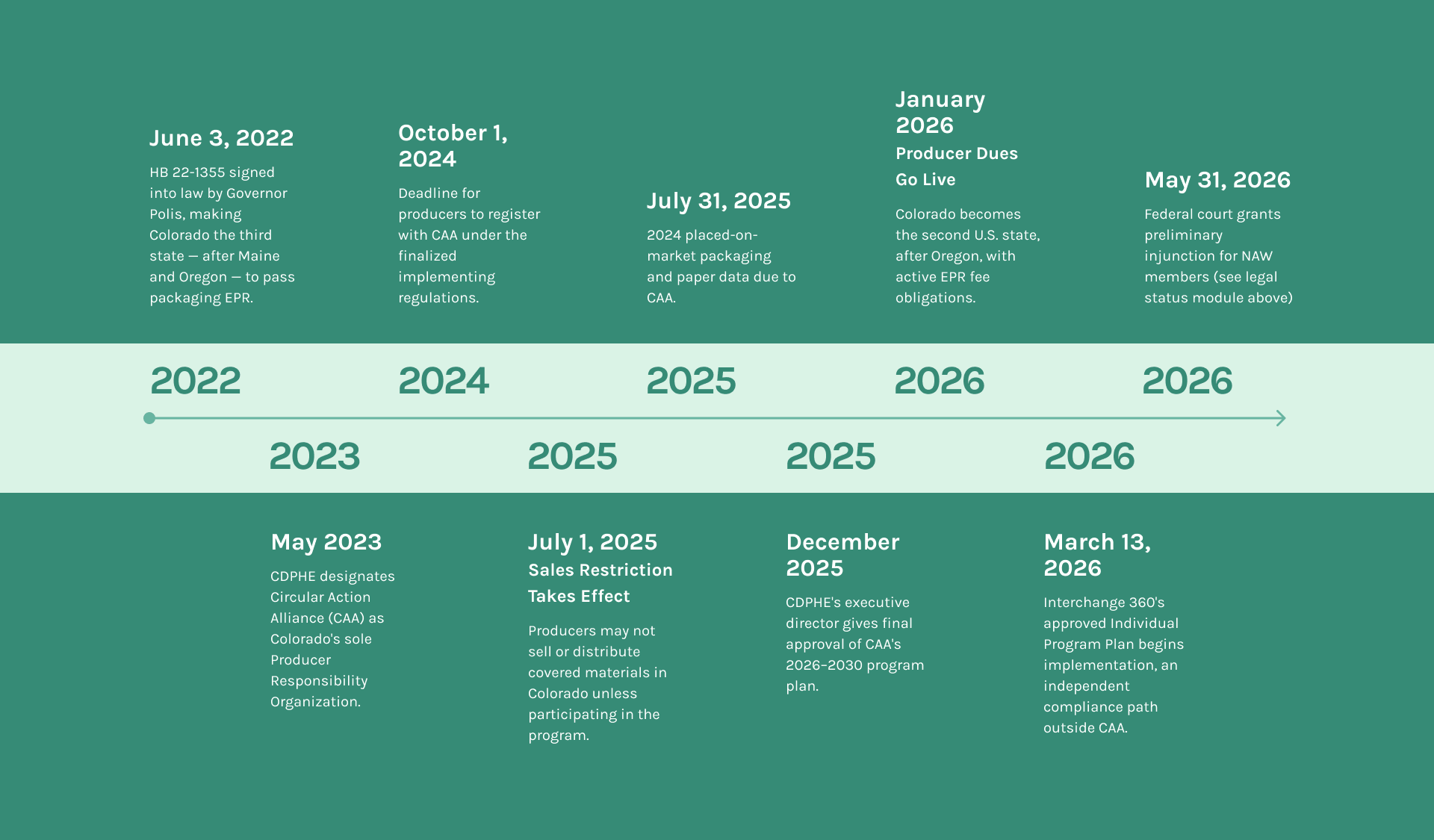
Colorado EPR Timeline: Key Dates and Milestones
What Producers Are Required to Do
- Register with Circular Action Alliance (or an approved independent program plan) — initial registration closed October 1, 2024, but new producers must register before selling into Colorado
- Report supply data annually on the type and weight of covered materials placed into the Colorado market
- Pay producer responsibility dues to CAA, live since January 2026 and due annually each January thereafter
- Keep records that document compliance with the Act and its regulations
Penalties for non-compliance:
Escalating civil penalties plus loss of market access. First violation: $5,000 plus $1,500 per day it continues. Second violation: $10,000 plus $3,000 per day. Third and subsequent violations: $20,000 plus $6,000 per day. Penalties are deposited into Colorado’s Recycling Resources Economic Opportunity Fund.
How Colorado EPR Fees Work
Colorado uses a bonus-malus eco-modulation model — the same core idea behind Oregon’s and California’s fee structures, applied a little differently. Automatic passive factors are already built into the 2026 dues rates, based on supply data:
- A +5% malus for materials that disrupt the recycling of other materials
- A -5% credit for materials with high recycling rates — this is where paper tubes are built to land
- Materials outside the state’s Minimum Recyclable List (MRL) carry meaningfully higher surcharges, tiered by how far outside the collection system they fall
- Active incentives (values not yet finalized by CAA) exist for clear on-pack recycling instructions, Colorado-origin recycled content, certified compostability, and recyclability case studies
Estimate Your Colorado EPR Fees
Get a fast, ballpark estimate of your Colorado EPR obligation based on your packaging volume, material mix, and revenue. This is an estimate to help you plan — final fees are determined by Circular Action Alliance.
Want a precise number or help with registration and reporting?
FAQ SECTION
What is EPR in Colorado?
Extended Producer Responsibility (EPR) is a policy that makes companies financially responsible for recycling the packaging and paper products they put on the market, rather than leaving those costs to local governments and residents.
Who has to comply with Colorado's HB 22-1355?
Any business that makes, sells, imports, distributes, or prints packaging materials or paper products sold into Colorado — unless it qualifies for the small-producer exemption (under roughly $5.6M in global revenue or under 1 metric ton of covered material into Colorado per year).
What is Circular Action Alliance?
Circular Action Alliance (CAA) is the nonprofit Producer Responsibility Organization Colorado designated in May 2023 to manage registration, fee collection, and reporting on behalf of producers. Some producers may also run an approved independent program plan instead.
How much are Colorado EPR fees?
Fees vary by material type and weight, adjusted up or down through Colorado’s bonus-malus eco-modulation system. There’s no flat statewide rate — use the calculator above for an estimate specific to your packaging mix.
What happens if I don't comply?
Non-compliance escalates fast: $5,000 plus $1,500/day for a first violation, up to $20,000 plus $6,000/day for repeat violations, on top of the risk of losing the ability to legally sell into Colorado at all.
Does paper packaging cost less to comply with than plastic?
Generally, yes. Colorado’s eco-modulation model credits materials with high recycling rates and penalizes materials that disrupt recycling or fall outside the state’s approved collection list, so paper-based packaging typically lands in a better fee position than plastic or plastic-coated formats.
How is Colorado's law different from Oregon's or California's EPR laws?
All three share Circular Action Alliance as a PRO option and a producer-funded model, but Colorado’s is the only one of the three using a bonus-malus system with no life-cycle-assessment requirement, and its penalty structure escalates per violation rather than capping at one flat daily maximum. Colorado and Oregon are also the only two states with EPR fees actually being invoiced today.
[Link to sibling state pages when built — Oregon EPR, California EPR, etc.]
Latest on Colorado EPR

Who Does the Oregon EPR Injunction Actually Affect? (It’s Not Who You Think)

What Is “Mega May”? The 6-State EPR Reporting Deadline Every Brand Needs to Know.
Paper vs. Plastic: Why EPR Fees Are Up to 10x Higher for Plastic Packaging
California SB 54 Is Now Law: What Brands Must Do Before June 1, 2026
Oregon EPR Glossary
- EPR (Extended Producer Responsibility): A policy model requiring producers to fund the end-of-life management of the products/packaging they sell.
- PRO (Producer Responsibility Organization): A nonprofit that manages compliance, fee collection, and reporting on behalf of producers. CAA is Colorado’s designated PRO.
- Covered Materials: Packaging materials and paper products subject to HB 22-1355, spanning paper, plastic, glass, metal, cartons, foam, and food service ware.
- Producer: The entity legally responsible for compliance — typically the Colorado brand owner, or otherwise the manufacturer, first importer, first distributor, or printer of the covered material.
- Eco-Modulation (Bonus-Malus): Colorado’s fee adjustment model — automatic credits (“bonus”) for high-recycling-rate materials, automatic surcharges (“malus”) for materials that disrupt recycling or fall outside the approved collection list.
- Minimum Recyclable List (MRL): Colorado’s statewide list of materials confirmed recyclable through the standard collection system; materials outside it carry higher fees.
- Individual Program Plan (IPP): An independent compliance path some producers may run instead of joining CAA, subject to CDPHE approval.
Need Help With Colorado EPR Compliance?
Whether you’re figuring out if you qualify as a producer, estimating fees, or looking for lower-fee packaging alternatives, our team can help.
This page is provided for general informational purposes and reflects publicly available information as of August 2026. It is not legal advice. EPR regulations are actively evolving, and exemption thresholds and fee schedules are adjusted annually — consult CDPHE, Circular Action Alliance, or your legal counsel for guidance specific to your business.