California EPR Law: The Complete Guide for Packaging Producers
- Trusted by 12 brands navigating packaging compliance
- 7 states with EPR laws — $50,000/day max penalty in California
- SB 54 signed into law 2022
Current Legal Status
Updated August 2026
Important: A First Amendment challenge to SB 343 — the “truth in labeling” law that SB 54 borrows its recyclability definitions from — is working through the courts. It has not paused SB 54 registration, reporting, or fee obligations for producers. Continue to comply on the current timeline while the litigation proceeds.
2022
Year California’s SB 54 was signed into law
June 1, 2026
Producer registration deadline
$1M
Small producer exemption threshold (CA gross sales)
Circular Action Alliance
California’s approved PRO
$50,000/day
Maximum penalty per violation
What Is California's SB 54?
California’s Plastic Pollution Prevention and Packaging Producer Responsibility Act (SB 54), signed in 2022, moves the cost of dealing with single-use packaging and plastic food service ware off cities and taxpayers and onto the businesses putting that material into the California market.
It’s the largest EPR program in the country — CalRecycle estimates it will reach more than 5,700 producers, funding roughly $500 million a year for plastic pollution mitigation once fees begin in 2027. Oregon’s RMA got there first; California’s is the one that made every other brand pay attention.
"Why it exists":
- Packaging makes up more than half the material in California landfills, and recycling infrastructure has historically been funded by ratepayers, not producers.
- SB 54 creates a producer-funded revenue source — the Plastic Pollution Mitigation Fund — for cleanup, recycling infrastructure, and environmental justice communities.
- It sets hard source-reduction and recyclability targets, pushing brands toward less packaging and materials that actually get recycled, not just labeled that way.
By 2032, producers must collectively ensure:
- 100% of single-use packaging and plastic food service ware sold in California is recyclable or compostable
- 65% of single-use plastic packaging is actually recycled
- A 25% reduction in single-use plastic packaging and food service ware, by weight, vs. 2023 volumes
Why Paper Wins Under SB 54
SB 54’s fees are eco-modulated — material that’s genuinely recyclable costs less; material that isn’t costs more. Paper tubes are FSC certified, compostable, and biodegradable by design, which puts them in a materially better fee position than plastic or plastic-coated packaging before a single ounce ships. This isn’t a workaround for the law. It’s what the law is built to reward.
This is not a footnote to your compliance strategy — for brands re-evaluating packaging ahead of a California launch or rebrand, it’s often the single biggest lever available. One tube at a time, we’re planting trees through our One Tree Planted partnership on top of it.
Are You a “Producer” Under California's EPR Law?
If your business makes, sells, imports, or brands packaged products or plastic food service ware in California, you may be a “covered producer” — even if you don’t manufacture the packaging yourself.
Covered materials include:
- Single-use packaging — primary, secondary, or tertiary — that is routinely disposed of or discarded after use, across all material classes: glass, ceramic, metal, paper and fiber, plastic, and wood/organics
- Single-use plastic food service ware (trays, cups, clamshells, utensils, wraps, bags, and plastic-coated paper or paperboard)
Who counts as the “producer”?
- The owner of the brand or trademark under which the covered product is sold in California
- If that owner is outside the state, the exclusive licensee of the brand
- If neither applies, the person or company that sells, offers for sale, or distributes the product into California
Who's exempt?
- Businesses with less than $1 million in gross annual sales in California in the most recent calendar year
- Note: this exemption is NOT automatic — producers must still register with CalRecycle and formally apply, and must reapply every two years
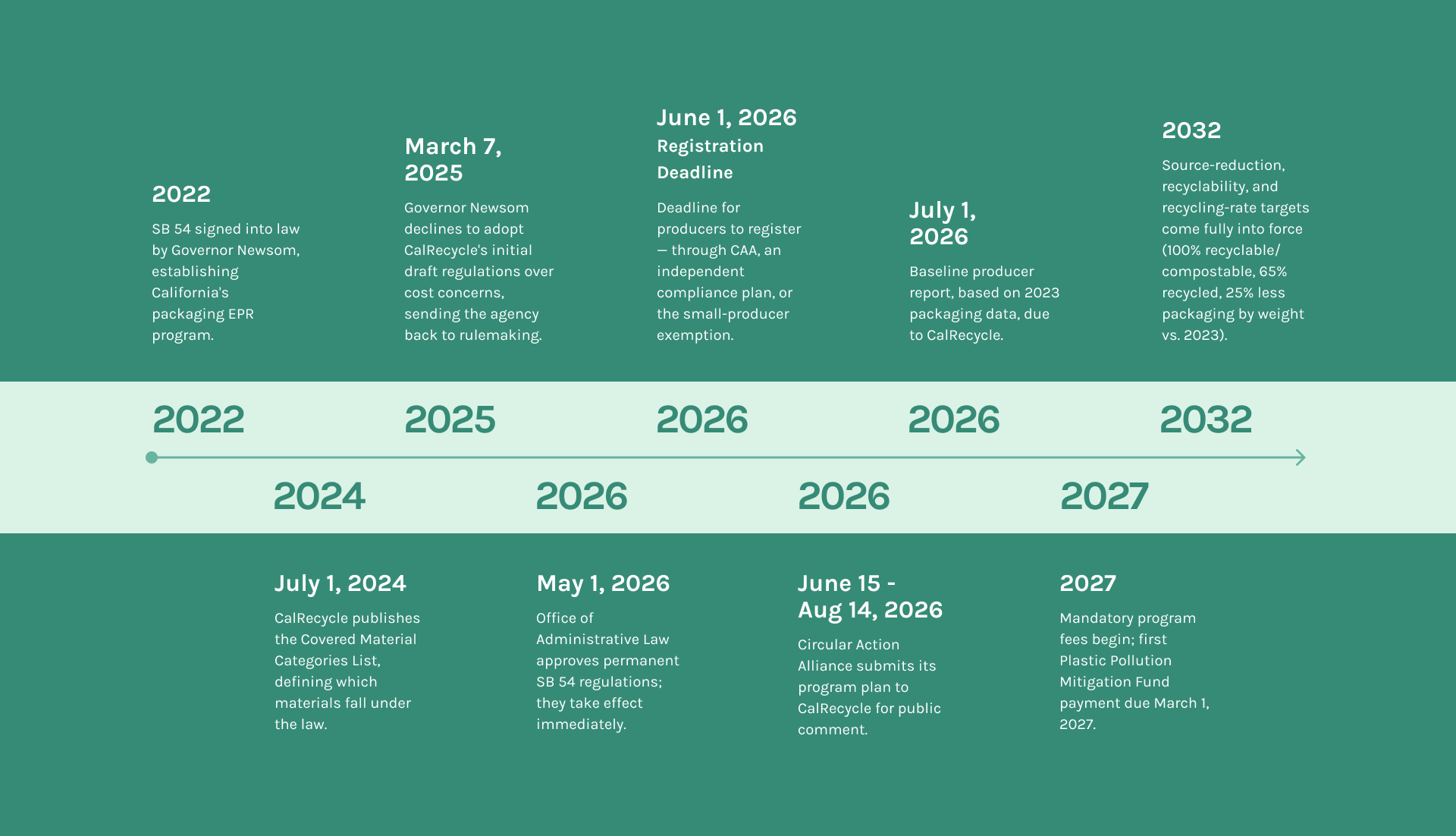
California EPR Timeline: Key Dates and Milestones
What Producers Are Required to Do
- Register with CalRecycle by June 1, 2026 (or within 30 days of becoming a producer after that date, tightening to within 6 months for producers who arise after January 1, 2027)
- Choose a compliance path: join Circular Action Alliance (CAA), register an independent compliance plan directly with CalRecycle, or formally apply for the small-producer exemption
- Report supply data on the type, weight, and category of covered material placed into the California market
- Pay program fees — calculated by material type, weight, and eco-modulation — once mandatory fees begin in 2027
- Meet the state's 2032 source-reduction, recyclability, and recycling-rate targets
Penalties for non-compliance:
How California EPR Fees Work
Fees are based on the weight and material type of covered packaging a producer places into California, adjusted through “eco-modulation” — the same core mechanism Oregon and other EPR states use.
- Lower fees for packaging that uses less material, more post-consumer recycled content, or is easier to recycle — this is where paper tubes are built to land
- Higher fees for packaging that’s harder to recycle, non-recyclable, or contains materials of concern — most plastic and plastic-coated formats
- Program scale: producers are expected to fund roughly $500 million a year — $5 billion over 10 years — into the Plastic Pollution Mitigation Fund starting in 2027
Estimate Your California EPR Fees
Get a fast, ballpark estimate of your California EPR obligation based on your packaging volume, material mix, and revenue. This is an estimate to help you plan — final fees are determined by Circular Action Alliance or CalRecycle.
Want a precise number or help with registration and reporting?
FAQ SECTION
What is EPR in California?
Extended Producer Responsibility (EPR) is a policy that makes companies financially responsible for the recycling and disposal of the single-use packaging and plastic food service ware they put on the market, rather than leaving those costs to cities and taxpayers.
Who has to comply with California's SB 54?
Any business that makes, brands, imports, or sells single-use packaging or plastic food service ware into California — unless it qualifies for the small-producer exemption (under $1 million in California gross sales, applied for and renewed every two years).
What is Circular Action Alliance?
Circular Action Alliance (CAA) is California’s approved Producer Responsibility Organization. Producers who join CAA delegate reporting and fee payment to it; producers can also register directly with CalRecycle under an independent compliance plan.
How much are California EPR fees?
Fees vary by material type and weight, and are adjusted (eco-modulated) based on recyclability and recycled content. There’s no flat statewide rate — use the calculator above for an estimate specific to your packaging mix.
What happens if I don't comply?
Non-compliance can result in penalties of up to $50,000 per day per violation — the highest of any U.S. EPR state — with a reduced $25,000/day cap available to qualifying small producers. Penalties don’t start until 30 days after a formal Notice of Violation.
Does paper packaging cost less to comply with than plastic?
Generally, yes. SB 54’s eco-modulated fee structure rewards recyclability and penalizes harder-to-recycle materials, so paper-based packaging typically lands in a lower fee tier than plastic packaging and plastic-coated food service ware — one more reason a growing number of brands are rethinking materials ahead of a compliance deadline, not just after one.
How is California's law different from Oregon's or Colorado's EPR laws?
All three share Circular Action Alliance as a PRO option and a similar producer-funded model, but California’s SB 54 is scoped to single-use packaging and plastic food service ware specifically, carries the highest per-day penalty in the country, and layers in hard 2032 source-reduction and recyclability targets that Oregon’s RMA does not include in the same form. [Link to sibling state pages when built — Oregon EPR, Colorado EPR, etc.]
Latest on Colorado EPR

Who Does the Oregon EPR Injunction Actually Affect? (It’s Not Who You Think)

What Is “Mega May”? The 6-State EPR Reporting Deadline Every Brand Needs to Know.
Paper vs. Plastic: Why EPR Fees Are Up to 10x Higher for Plastic Packaging
California SB 54 Is Now Law: What Brands Must Do Before June 1, 2026
California EPR Glossary
- EPR (Extended Producer Responsibility): A policy model requiring producers to fund the end-of-life management of the products/packaging they sell.
- PRO (Producer Responsibility Organization): A nonprofit that manages compliance, fee collection, and reporting on behalf of producers. CAA is California’s approved PRO; producers may also register independently.
- Covered Material: Single-use packaging (all material classes) and single-use plastic food service ware subject to SB 54.
- Producer: The entity legally responsible for compliance — typically the brand or trademark owner, its exclusive licensee, or the first seller/distributor into California.
- Eco-Modulation: Fee adjustments based on a product’s environmental impact (material type, recyclability, recycled content).
- Plastic Pollution Mitigation Fund (PPMF): The fund producer fees pay into — roughly $500 million a year beginning 2027 — used for plastic pollution cleanup and environmental justice programs.
- PEPRS: The Packaging EPR System — CalRecycle’s online portal for producer registration, data submission, and compliance tracking.
Need Help With California EPR Compliance?
Packaging that Gets Noticed. Eco-friendly. Finely crafted. For global brands and local artisans — and now, built for what California requires.