Minnesota HF 3911 | Packaging that Gets Noticed
Minnesota EPR Law: The Complete Guide for Packaging Producers
Minnesota’s Packaging Waste and Cost Reduction Act is already underway — producer registration opened in 2025, and the state is building toward live fee obligations in 2029. This page breaks down who’s covered, what’s required today, and what it will eventually cost, plus a free calculator to estimate your obligation.
- Trusted by 12 brands navigating packaging compliance
- 7 states with enacted packaging EPR laws
- Minnesota is the fifth Registration with Minnesota's PRO has been open since 2025
Current Legal Status
Updated August 2026
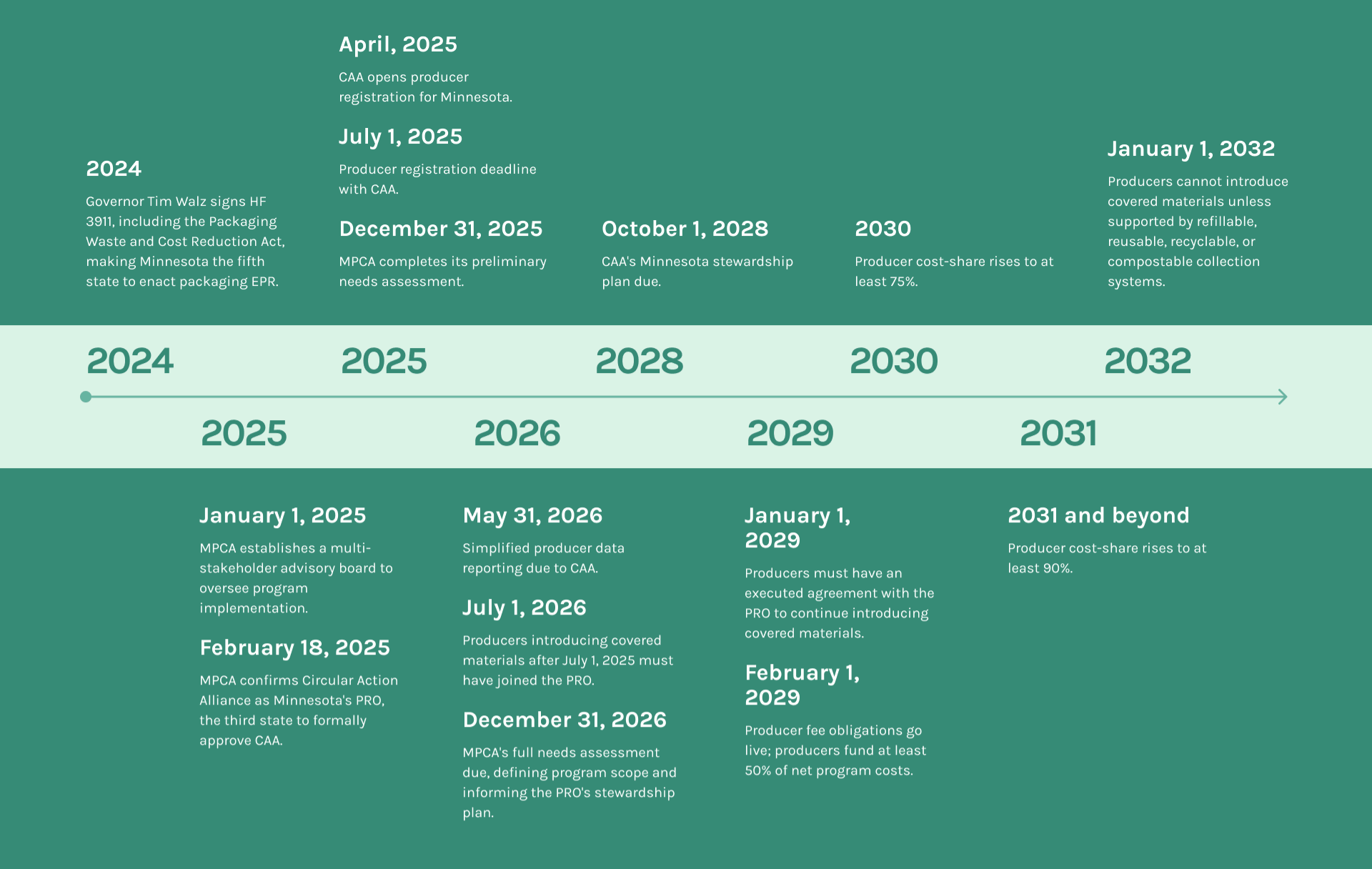
Minnesota’s Packaging Waste and Cost Reduction Act, part of HF 3911, is enacted and moving through implementation — but producer fee obligations aren’t live yet. The Minnesota Pollution Control Agency (MPCA) confirmed Circular Action Alliance (CAA) as the state’s Producer Responsibility Organization (PRO) on February 18, 2025, and producer registration with CAA opened that April, with a registration deadline of July 1, 2025 already passed. Simplified data reporting is due May 31, 2026, to align with CAA’s registration requirements.
Unlike Oregon and Colorado, Minnesota producers do not owe fees yet. Under the statute, producers will fund at least 50% of net program costs starting February 1, 2029, rising to 75% in 2030 and 90% in 2031 and beyond. If your business sells into Minnesota and hasn’t registered with CAA, that’s the immediate gap to close — the fee clock hasn’t started, but the registration and reporting clock has.
2024
Year Minnesota’s HF 3911 was signed into law February 18, 2025 — Circular Action Alliance confirmed as Minnesota’s PRO
February 18, 2025
$2M / 1 ton
February 1, 2029
Up to $100,000/day
Escalating penalties for repeat violations, once a stewardship plan is approved
What Is Minnesota's Packaging Waste and Cost Reduction Act?
"Why it exists":
- Minnesota’s recycling, composting, and reuse infrastructure varies widely by community, with costs historically falling on local governments and residents.
- HF 3911 shifts a growing share of those costs onto the producers who put packaging on the market, phased in gradually so the system has time to scale.
- An eco-modulated fee structure is built into the law from the start, rewarding materials and design choices that reduce environmental and health impacts.
Why Paper Wins Under Minnesota's Law
Minnesota’s law explicitly incentivizes producers’ use of materials and design attributes that reduce environmental and human health impacts — the same eco-modulated logic used in Oregon and Colorado, where recyclable, low-disruption materials are rewarded and materials that gum up the recycling stream are penalized. Paper tubes are positioned well against that standard by design: FSC certified, compostable, and biodegradable, with none of the sorting complications that come with mixed-material or flexible plastic formats.
Minnesota’s 2032 target — recyclable, reusable, refillable, or compostable packaging backed by real collection systems — is also a longer runway than any other enacted EPR state, giving producers real time to shift material mix before fee obligations peak. One tube at a time, we’re planting trees through our One Tree Planted partnership on top of it.
Are You a “Producer” Under Minnesota's EPR Law?
If your business makes, sells, imports, distributes, or licenses the brand on packaging or paper products sold into Washington, you may be a “covered producer” — even if you don’t manufacture the packaging yourself.
Covered materials include:
- most types of packaging and paper products introduced into Minnesota, for household or business use, including a first-in-the-nation inclusion of boat wrap (the plastic film used to protect stored boats)
- Paper products — most paper sold for personal use, though bound books, newspapers, copy paper, and construction paper are excluded
Who counts as the “producer”?
- The manufacturer, importer, or brand owner of the product sold in packaging in Minnesota
Who's exempt?
Businesses with less than 1 ton of covered packaging and paper material introduced into Minnesota per year, OR less than $2,000,000 in global gross revenue — either condition alone qualifies (Minn. Stat. § 115A.1441, subd. 13) Products specifically exempted by statute, including infant formula, medical foods and equipment, drugs and medical devices, and fortified oral nutrient supplements required for medical purposes
Note: exemption thresholds are set in statute but should be reconfirmed as MPCA’s needs assessment and the PRO’s stewardship plan take shape through 2028
If your business makes, sells, imports, distributes, or licenses the brand on packaging or paper products sold into Washington, you may be a “covered producer” — even if you don’t manufacture the packaging yourself.
Minnesota EPR Timeline: Key Dates and Milestones
What Producers Are Required to Do
- Register with Circular Action Alliance, Minnesota's designated PRO — the initial registration deadline of July 1, 2025 has passed, but producers introducing covered materials for the first time must still register before selling into the state
- Report supply data annually — simplified reporting is due each May 31 to align with CAA's Minnesota requirements
- Prepare for phased fee payments — obligations begin February 1, 2029, and ramp from 50% to 90% of net program costs over the following two years
- Keep records that document compliance with the Act and its regulations, including boat wrap if applicable to your business
- Meet performance standards the PRO sets under Ecology's oversight, including future eco-modulated fee schedules
Penalties for non-compliance:
Civil penalties of up to $25,000 per day for a first violation, $50,000 per day for a second violation within five years of stewardship plan approval, and $100,000 per day for a third violation (Minn. Stat. § 115A.1462(c)). None of these penalties can accrue until a stewardship plan is approved, which is expected by October 1, 2028.
How Minnesota EPR Fees Will Work
Minnesota’s law commits to an eco-modulated fee structure, meaning materials and design choices that reduce environmental and health impacts are rewarded with lower fees — but, like several details of the program, the specific fee schedule won’t be finalized until closer to the 2029 launch.
What’s set in statute today: Producers fund at least 50% of net covered-service costs starting February 1, 2029 That share rises to at least 75% in 2030, and at least 90% in 2031 and every year after MPCA’s needs assessment, due December 31, 2026, will help set the baselines the fee structure is built from The PRO’s stewardship plan, due October 1, 2028, will translate those baselines into an actual per-producer fee methodology
Estimate Your Minnesota EPR Fees
Get a directional estimate of your future Minnesota EPR obligation based on your packaging volume, material mix, and revenue. This is a planning tool ahead of the 2029 fee launch — final fees will be set through CAA’s approved Minnesota stewardship plan.
Want help with registration, reporting, or long-range fee planning?
FAQ SECTION
What is EPR in Minnesota?
Extended Producer Responsibility (EPR) is a policy that makes companies financially responsible for recycling the packaging and paper products they put on the market, rather than leaving those costs to local governments and residents. Minnesota’s version is the Packaging Waste and Cost Reduction Act, part of HF 3911.
Who has to comply with Minnesota's EPR law?
Any business that makes, sells, imports, distributes, or prints packaging or paper products sold into Minnesota — unless it qualifies for the small-producer exemption (under 1 ton of covered material into Minnesota per year, or under $2,000,000 in global revenue).
Do I need to register with Minnesota's PRO right now?
Yes. Circular Action Alliance is Minnesota’s confirmed PRO, and registration has been open since April 2025. Fee obligations don’t begin until 2029, but registration and annual reporting are already required.
How much are Minnesota EPR fees?
Fees haven’t been finalized yet. Producers will fund at least 50% of net program costs starting February 1, 2029, rising to 90% by 2031, with an eco-modulated structure rewarding sustainable material and design choices. Use the calculator above for a directional estimate.
What happens if I don't comply?
Once a stewardship plan is approved (expected October 1, 2028), non-compliance escalates fast: $25,000 per day for a first violation, up to $100,000 per day for a third violation within five years.
Does paper packaging cost less to comply with than plastic in Minnesota?
Minnesota’s statute directs its eco-modulated fee structure to reward materials and design attributes that reduce environmental and health impacts, which typically favors recyclable, paper-based packaging over plastic or plastic-coated formats — consistent with how other states’ eco-modulation systems have shaken out.
How is Minnesota's law different from Oregon's or Colorado's?
Minnesota shares Circular Action Alliance as its PRO with Oregon and Colorado, but its fee obligations don’t begin until 2029 — years later than Oregon (2025) and Colorado (2026) — giving producers a longer runway to prepare. Minnesota is also the only state to explicitly include boat wrap as a covered material.
Latest on Washington EPR

Oregon’s EPR Law Just Survived Its First Constitutional Trial – What It Means for Every Producer

Who Does the Oregon EPR Injunction Actually Affect? (It’s Not Who You Think)

What Is “Mega May”? The 6-State EPR Reporting Deadline Every Brand Needs to Know.
Paper vs. Plastic: Why EPR Fees Are Up to 10x Higher for Plastic Packaging
California SB 54 Is Now Law: What Brands Must Do Before June 1, 2026
Minnesota EPR Glossary
- EPR (Extended Producer Responsibility): A policy model requiring producers to fund the end-of-life management of the products/packaging they sell.
- PRO (Producer Responsibility Organization): A nonprofit that manages compliance, fee collection, and reporting on behalf of producers. CAA is Minnesota’s designated PRO.
- Covered Materials: Packaging materials and paper products subject to HF 3911, including a unique inclusion of boat wrap.
- Producer: The entity legally responsible for compliance — typically the manufacturer, importer, or brand owner of the covered material sold into Minnesota.
- Eco-Modulation: Minnesota’s fee adjustment model, incentivizing materials and design attributes that reduce environmental and human health impacts, though specific bonus/malus values are not yet finalized.
- Needs Assessment: MPCA’s statutorily required study (preliminary due December 31, 2025; full version due December 31, 2026) evaluating recycling, composting, reuse, and return infrastructure to inform the stewardship plan
- Stewardship Plan: CAA’s Minnesota program plan, due October 1, 2028, which will set performance targets and the actual fee methodology producers pay under starting 2029.
Need Help With Minnesota EPR Compliance?
Whether you’re registering with CAA for the first time, reporting your annual data, or planning ahead for 2029 fee obligations, our team can help.
Sourced from MPCA, Circular Action Alliance guidance, and current legal/industry coverage of HF 3911 as of August 2026. Recommend legal review before publishing, particularly the penalty figures and 2029 fee ramp, which are set in statute but may be refined through MPCA’s needs assessment and CAA’s stewardship plan.