Maine EPR Law: The Complete Guide for Packaging Producers
Maine was the first state in the country to pass a packaging EPR law, back in 2021. Five years later, it’s the only enacted state with no organization in place to run it. This page breaks down what’s actually required of producers today, what’s stalled, and how to stay ahead of it.
- Trusted by 12 brands navigating packaging compliance
- 7 states with enacted packaging EPR laws
- Maine passed the first, in 2021 0 proposals received for Maine's Stewardship Organization contract (as of August 2026)
Current Legal Status
Updated August 2026
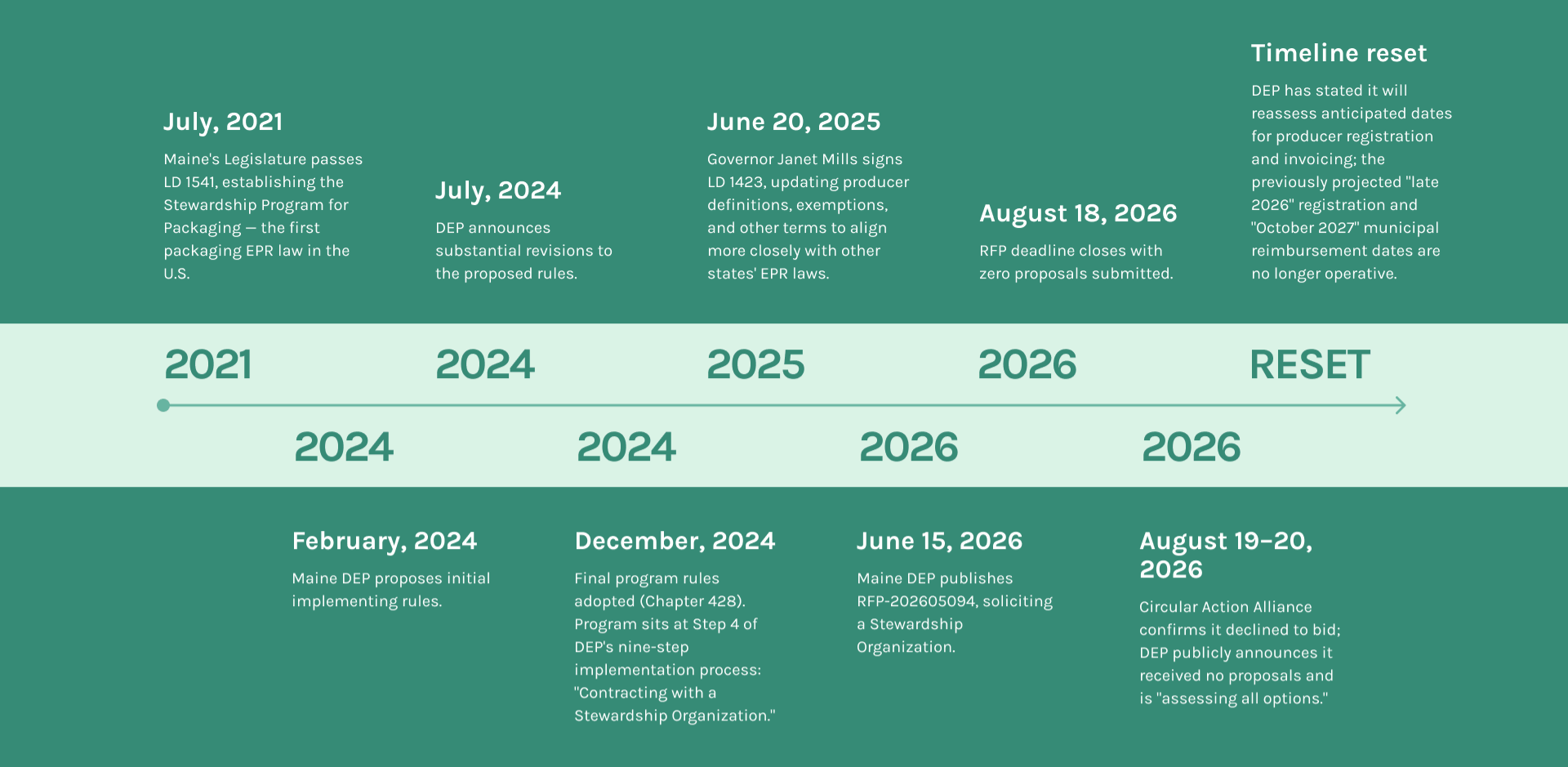
Maine is currently the only U.S. state with an enacted packaging EPR law and no organization in place to administer it. On August 20, 2026, Maine’s Department of Environmental Protection (DEP) announced it received zero proposals in response to its Request for Proposals (RFP-202605094) to serve as the state’s Stewardship Organization (SO) — Maine’s term for what most other states call a Producer Responsibility Organization (PRO). Circular Action Alliance (CAA), the PRO active in six other EPR states, publicly declined to bid, citing misalignment between the RFP’s scope and its operational practices.
With no Stewardship Organization under contract, there is currently no registration, no reporting, and no fee obligation for producers under Maine’s law. The registration clock only begins within 90 days of an SO making a registration mechanism available — and there is no SO. DEP has said it is “assessing all options” and will share updates in a future newsletter. If you sell packaging or paper products into Maine, this is a program to watch closely, not one with an active deadline today.
2021
Year Maine’s original packaging EPR law (LD 1541) was signed, the first in the nation
December 2024
Final program rules adopted (Chapter 428)
$2M /
1 ton
0
Proposals received for the Stewardship Organization contract as of August 2026
No SO
Maine has no Producer Responsibility Organization or Stewardship Organization under contract
What Is Washington's Recycling Reform Act?
In July 2021, the Maine Legislature passed a law establishing the state’s Stewardship Program for Packaging (38 M.R.S. § 2146) — the first packaging EPR law of any kind in the United States. Rather than the “producer fee funds a PRO’s recycling investments” model used by states like Oregon and Colorado, Maine’s original design centers on cost reimbursement: municipalities that opt into the program get reimbursed for the cost of recycling packaging material, funded by dues paid by producers.
In June 2025, Governor Janet Mills signed LD 1423, “An Act to Improve Recycling by Updating the Stewardship Program for Packaging,” which brought Maine’s definitions of producers, exemptions, and postconsumer recycled content more in line with other states’ EPR laws. The program’s final implementing rules (Chapter 428) were adopted in December 2024.
"Why it exists":
- Municipalities across Maine have borne the cost of managing packaging waste with little support from the companies that put that packaging on the market.
- The Stewardship Program shifts a share of those costs onto producers, funding reimbursements to participating municipalities.
- As the first-in-the-nation model, Maine’s law helped shape — and has since been reshaped by — the wave of packaging EPR laws that followed it in other states.
Why Paper Wins Under Maine's Law
Maine’s program is still finalizing its fee structure, but the core logic mirrors other states: materials that are genuinely recyclable and don’t disrupt the existing collection stream are positioned to carry a lighter cost burden than materials that do. Paper tubes — FSC certified, compostable, and biodegradable — are built for exactly that kind of positioning, regardless of which state’s eco-modulation formula eventually applies.
Maine also carves out a specific exemption most states don’t: the first 15 tons of packaging used for perishable food (bakery products, meat, poultry, seafood, dairy, shell eggs, and fresh produce) are exempt for every producer, every year. For food and beverage brands leaning on paper-based packaging, that’s a meaningful head start before any fee calculation even begins.
This is not a footnote to your compliance math — it’s a real lever on your eventual Maine dues. One tube at a time, we’re planting trees through our One Tree Planted partnership on top of it.
Are You a “Producer” Under Washington's EPR Law?
If your business makes, sells, imports, distributes, or licenses the brand on packaging or paper products sold into Washington, you may be a “covered producer” — even if you don’t manufacture the packaging yourself.
Covered materials include:
- Packaging materials — most types of packaging used to contain, protect, handle, or deliver products to consumers in Maine
Who counts as the “producer”?
- The brand owner of the product sold in packaging in Maine If there’s no identifiable brand owner, the entity that manufactures, imports, or distributes the covered material
Who's exempt?
- Businesses with less than $2,000,000 in global gross annual revenue OR under 1 ton of covered packaging material into Maine per year — either condition alone qualifies (38 MRSA 2146(2)) A transitional $5,000,000 revenue threshold applies for three years, starting one calendar year after the DEP and Stewardship Organization contract takes effect Perishable food producers get an automatic exemption on their first 15 tons of packaging annually Producers with more than 50% of gross revenue from insurance salvage, closeouts, bankruptcies, or liquidations Note: exemption thresholds and definitions were recently revised by LD 1423 — reconfirm your status once a Stewardship Organization and registration process are in place, rather than relying on pre-2025 guidance
If your business makes, sells, imports, or distributes packaging sold into Maine, you may be a “covered producer” once the program launches — even if you don’t manufacture the packaging yourself.
Maine EPR Timeline: Key Dates and Milestones
What Producers Are Required to Do
- (Once a Stewardship Organization Is in Place) Register with Maine's Stewardship Organization once one is under contract
- The registration window opens within 90 days of the SO making a registration mechanism available Report supply data on packaging material placed into the Maine market
- Maine's simplified supply report is the least detailed of any enacted EPR state, currently limited to estimated tonnage Pay stewardship program dues once fees are established, to fund reimbursements to participating municipalities
- Maintain detailed records and submit invoices for reimbursement where applicable
- Keep records that document compliance with the Act and its regulations, in preparation for a program that is expected to become active once an SO is contracted
Penalties for non-compliance:
Enforcement authority sits with Maine DEP under the Chapter 428 final rules. Because no Stewardship Organization is currently under contract, no registration, reporting, or fee obligations — and no associated penalties — can accrue today.
How Maine EPR Fees Are Expected to Work
Maine’s fee structure has not been finalized, since no Stewardship Organization has been selected to build it out. What’s known from the statute and Chapter 428 rules:
- Maine’s model is cost-reimbursement based, not a straight producer-fee-for-recycling-investment model like Oregon’s or Colorado’s
- Every producer is exempt on its first 15 tons of packaging used for perishable food
- A transitional $5,000,000 revenue exemption threshold phases in for three years once a Stewardship Organization contract takes effect Eco-modulation details — bonuses or maluses tied to material type or design — have not yet been finalized in Maine’s rules
Estimate Your Future Maine EPR Fees
Get a directional estimate of what your Maine obligation could look like once the program is operational, based on your packaging volume, material mix, and revenue. This is a planning tool — Maine’s actual fee structure won’t be finalized until a Stewardship Organization is under contract.
FAQ SECTION
What is EPR in Maine?
Extended Producer Responsibility (EPR) is a policy that makes companies financially responsible for the cost of recycling the packaging they put on the market. Maine’s version, the Stewardship Program for Packaging, was the first packaging EPR law passed in the U.S., in 2021.
Is Maine's packaging EPR law active right now?
The law is enacted and its implementing rules are final, but the program is not yet operational. Maine has no Stewardship Organization under contract, so there are currently no registration, reporting, or fee obligations for producers.
Why does Maine call its administrator a "Stewardship Organization" instead of a "PRO"?
Most states use the term Producer Responsibility Organization (PRO). Maine’s statute predates that convention and uses “Stewardship Organization” (SO) for the equivalent role — the entity that will handle registration, reporting, invoicing, and municipal reimbursements.
Why did no one bid to run Maine's program?
Maine’s RFP for a Stewardship Organization closed in August 2026 with zero proposals. Circular Action Alliance, the PRO active in six other EPR states, said the RFP’s scope didn’t align with its operational practices, systems, and data stewardship standards.
What happens if I don't register once a Stewardship Organization is finally selected?
Once an SO is under contract, producers get a 90-day window to register. Penalties for non-compliance are enforced by Maine DEP under the Chapter 428 rules, though specific penalty figures will likely be clarified alongside the SO’s operational rollout.
Does paper packaging cost less to comply with than plastic in Maine?
Maine’s eco-modulation structure hasn’t been finalized, but the statute’s overall direction — rewarding recyclable, low-disruption materials — mirrors other states where paper-based packaging typically lands in a better fee position than plastic.
How is Maine's law different from Oregon's or Colorado's?
Maine uses a cost-reimbursement model funding municipal recycling, rather than a producer-fee-funds-a-PRO’s-investments model. It’s also the only enacted EPR state without an active administering organization, meaning Oregon and Colorado currently have live fee obligations while Maine does not.
Latest on Washington EPR

Oregon’s EPR Law Just Survived Its First Constitutional Trial – What It Means for Every Producer

Who Does the Oregon EPR Injunction Actually Affect? (It’s Not Who You Think)

What Is “Mega May”? The 6-State EPR Reporting Deadline Every Brand Needs to Know.
Paper vs. Plastic: Why EPR Fees Are Up to 10x Higher for Plastic Packaging
California SB 54 Is Now Law: What Brands Must Do Before June 1, 2026
Maine EPR Glossary EPR
- (Extended Producer Responsibility): A policy model requiring producers to fund the end-of-life management of the products/packaging they sell.
- Stewardship Organization (SO): Maine’s term for the entity that will administer its packaging EPR program day-to-day — registration, reporting, invoicing, the stewardship fund, and municipal reimbursements. Equivalent to a PRO in other states.
- Covered Materials: Packaging materials subject to Maine’s Stewardship Program for Packaging.
- Producer: The entity legally responsible for compliance — typically the Maine brand owner, or otherwise the manufacturer, importer, or distributor of the covered material.
- De Minimis Threshold: Maine’s exemption line — under $2,000,000 in global gross revenue OR under 1 ton of covered material into Maine, either alone granting full exemption.
- Perishable Food Exemption: An automatic exemption on every producer’s first 15 tons of packaging used for bakery products, meat, poultry, seafood, dairy, shell eggs, or fresh produce.
- Chapter 428: Maine DEP’s final implementing rules for the Stewardship Program for Packaging, adopted December 2024.
Need Help Tracking Maine EPR Compliance?
Whether you’re figuring out if you’ll qualify as a producer, estimating future fees, or looking for lower-fee packaging alternatives while Maine’s timeline resets, our team can help.
Packaging that Gets Noticed. Eco-friendly. Finely crafted. For global brands and local artisans — and built to stay ahead of whatever Maine requires next.
Sourced from Maine DEP, EPR Atlas, and current legal/industry coverage of 38 M.R.S. § 2146, LD 1541, and LD 1423 as of August 2026. Recommend legal review before publishing — this program’s timeline is actively changing and should be re-verified close to publish date.