Oregon EPR Law:
The Complete Guide for Packaging Paper Producers
Oregon’s Recycling Modernization Act (RMA) was the first packaging EPR law in the U.S. — and it comes with real fees, deadlines, and penalties. This page breaks down who’s covered, what’s required, and what it costs, plus a free calculator to estimate your obligation.
- Trusted by 12 brands navigating packaging compliance
- 7 states with EPR laws - $25,000/day max penalty in Oregon
- Founded 2021
Current Legal Status
(Updated July 2026)
Oregon’s Recycling Modernization Act (RMA) was the first packaging EPR law in the U.S. — and it comes with real fees, deadlines, and penalties. This page breaks down who’s covered, what’s required, and what it costs, plus a free calculator to estimate your obligation.
Important: The injunction applies only to NAW members — it does not pause the law generally. Registration, reporting, and fee obligations remain active for all other producers. A trial on the merits is expected later in 2026.
2021
Year Oregon’s RMA (SB 582) was signed into law
July
2025
Producer fee obligations began
$5M
per 1 ton
Small producer exemption thresholds
Circular Action Alliance
Oregon’s only approved PRO
$25,000
per day
Maximum penalty for non-compliance
What Is Oregon's Recycling Modernization Act?
Oregon’s Plastic Pollution and Recycling Modernization Act (RMA), passed as Senate Bill 582 in 2021, is an Extended Producer Responsibility (EPR) law. It shifts the cost of recycling packaging, paper products, and food serviceware away from cities and taxpayers and onto the businesses that produce and sell those materials in Oregon.
Oregon was the first U.S. state to pass a comprehensive packaging EPR law, and its framework has become a model other states are now following, including California, Colorado, Maine, Maryland, and Minnesota.
"Why it exists":
- Recycling systems have historically been funded by local governments and ratepayers, not by the companies whose packaging enters the waste stream.
- The RMA creates a stable, producer-funded revenue source for sorting, processing, and collection infrastructure.
- It also builds in incentives (“eco-modulated fees”) that reward brands for using less packaging, more recycled content, and easier-to-recycle materials.
Are You a "Producer" Under Oregon's EPR Law?
If your business makes, sells, imports, or brands packaged products, paper, or food serviceware in Oregon, you may be a “covered producer” — even if you don’t manufacture the packaging yourself.
Covered materials include:
- Packaging (storage items, service packaging, shipping/moving materials — includes paperboard, plastic, glass, metal, flexible film, composite materials)
- Printing and writing paper
- Food serviceware (including wraps sold directly to consumers)
Who counts as the "producer"?
- Oregon uses a hierarchy to determine the responsible party:
The brand owner (or the party directing a contract manufacturer’s packaging specs) - The licensee of the brand under which the item is sold in Oregon
- The importer of the packaged item into the U.S.
- The first distributor of the item into Oregon (if none of the above apply)
Who's exempt?
- Businesses with less than $5 million in annual global revenue
- Businesses selling less than 1 metric ton of covered products into Oregon per year
- A single retail location with no online sales, not part of a chain or franchise
If your business makes, sells, imports, or brands packaged products, paper, or food serviceware in Oregon, you may be a “covered producer” — even if you don’t manufacture the packaging yourself.
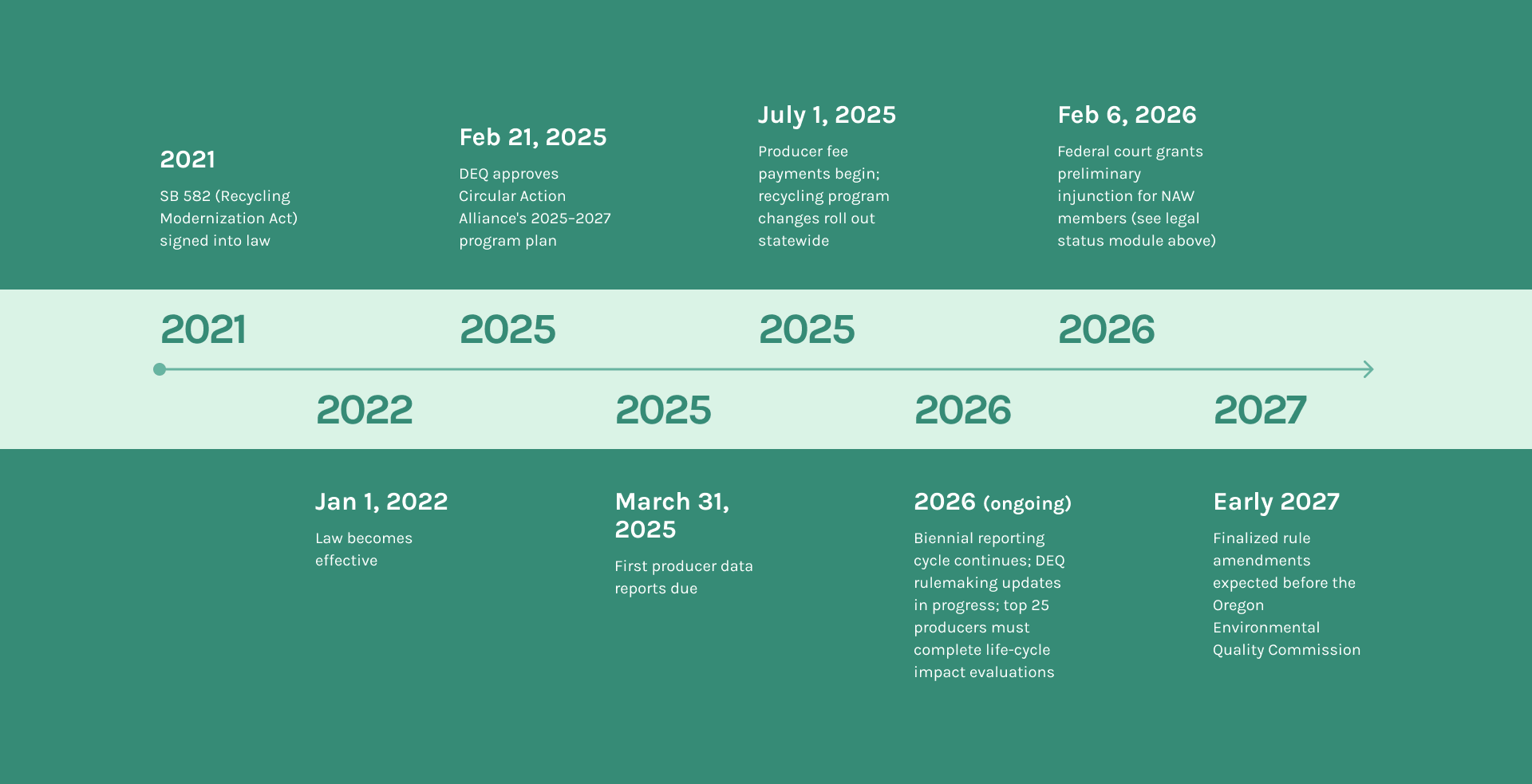
Oregon EPR Timeline: Key Dates and Milestones
What Producers Are Required to Do
- Register with Circular Action Alliance (CAA), Oregon's approved Producer Responsibility Organization
- Report data on the type and quantity of covered products supplied into Oregon
- Pay membership fees to the PRO, based on weight/volume and material type
- (Top 25 producers only): Conduct and publicly disclose life-cycle impact evaluations on at least 1% of covered products every two years
Penalties for non-compliance:
up to $25,000 per day, with the exact amount based on severity and history.
How Oregon EPR Fees Work
Fees are based on the weight and material type of packaging a producer supplies into Oregon. The program uses “eco-modulation” — fees are adjusted up or down based on environmental impact:
- Lower fees for packaging that uses less material, more post-consumer recycled content, or is easier to recycle
- Higher fees for packaging that’s harder to recycle or contains materials of concern
- Bonus programs are available for producers who complete verified life-cycle assessments (LCAs) showing measurable improvements
Estimate Your Oregon EPR Fees
Get a fast, ballpark estimate of your Oregon EPR obligation based on your packaging volume, material mix, and revenue. This is an estimate to help you plan — final fees are determined by the Circular Action Alliance.
Want a precise number or help with registration and reporting?
FAQ SECTION
What is EPR in Oregon?
EPR (Extended Producer Responsibility) is a policy that makes companies financially responsible for the recycling and disposal of the packaging, paper, and food serviceware they put on the market, rather than leaving those costs to cities and taxpayers.
Who has to comply with Oregon's EPR law?
Any business that makes, brands, imports, or first distributes packaging, paper products, or food serviceware into Oregon — unless it qualifies for the small-producer exemption (under $5M in revenue or under 1 ton of covered product annually).
What is Circular Action Alliance?
Circular Action Alliance (CAA) is the only Producer Responsibility Organization approved by Oregon DEQ. Producers register with CAA, report their data through it, and pay their fees to it.
How much are Oregon EPR fees?
Fees vary by material type and weight, and are adjusted (eco-modulated) based on recyclability and recycled content. There’s no flat statewide rate — use the calculator above for an estimate specific to your packaging mix.
What happens if I don't comply?
Non-compliance can result in penalties of up to $25,000 per day, with the amount depending on the nature and duration of the violation.
Is Oregon's EPR law still in effect after the court ruling?
Yes, with one exception. A February 2026 federal injunction paused enforcement only against members of the National Association of Wholesaler-Distributors while a legal challenge proceeds. All other producers remain subject to the law’s registration, reporting, and fee requirements.
How is Oregon's law different from California's or Colorado's EPR laws?
All use a similar producer-funded model and share Circular Action Alliance as their PRO, but timelines, fee structures, and specific requirements differ by state. (Link to sibling state pages when built — California EPR, Colorado EPR, etc.)
Latest on Oregon EPR

Who Does the Oregon EPR Injunction Actually Affect? (It’s Not Who You Think)

What Is “Mega May”? The 6-State EPR Reporting Deadline Every Brand Needs to Know.
Paper vs. Plastic: Why EPR Fees Are Up to 10x Higher for Plastic Packaging
California SB 54 Is Now Law: What Brands Must Do Before June 1, 2026
Oregon EPR Glossary
- EPR (Extended Producer Responsibility): A policy model requiring producers to fund the end-of-life management of the products/packaging they sell.
- PRO (Producer Responsibility Organization): A nonprofit that manages compliance, fee collection, and reporting on behalf of producers. CAA is Oregon’s only approved PRO.
- Covered Products: Packaging, printing/writing paper, and food serviceware subject to the RMA.
- Producer: The entity legally responsible for compliance — typically the brand owner, licensee, importer, or first distributor.
- Eco-Modulation: Fee adjustments based on a product’s environmental impact (material type, recyclability, recycled content).
- Uniform Statewide Collection List (USCL): The list of materials approved for standard curbside/commingled recycling collection statewide.
- Life Cycle Assessment (LCA): A cradle-to-grave environmental impact evaluation required for Oregon’s top 25 producers.
Need Help With Oregon EPR Compliance?
Whether you’re figuring out if you qualify as a producer, estimating fees, or looking for lower-fee packaging alternatives, our team can help.
This page is provided for general informational purposes and reflects publicly available information as of July 2026. It is not legal advice. EPR regulations are actively evolving, including an ongoing federal court challenge to Oregon’s program — consult Oregon DEQ, Circular Action Alliance, or your legal counsel for guidance specific to your business.