Washington E2SSB 5284 | Packaging that Gets Noticed
Washington EPR Law: The Complete Guide for Packaging Producers
The Recycling Reform Act closed out the West Coast — Washington now requires the same producer registration Oregon and California already do. The July 1, 2026 PRO membership deadline has passed, so this is a compliance gap to close now, not a date to circle later. This page breaks down who’s covered, what’s required, and what it costs, plus a free calculator to estimate your obligation.
- Trusted by 12 brands navigating packaging compliance
- 7 states with EPR laws — Washington is the 7th, and the last on the West Coast
- Recycling Reform Act signed into law 2025
Current Legal Status
Updated August 2026
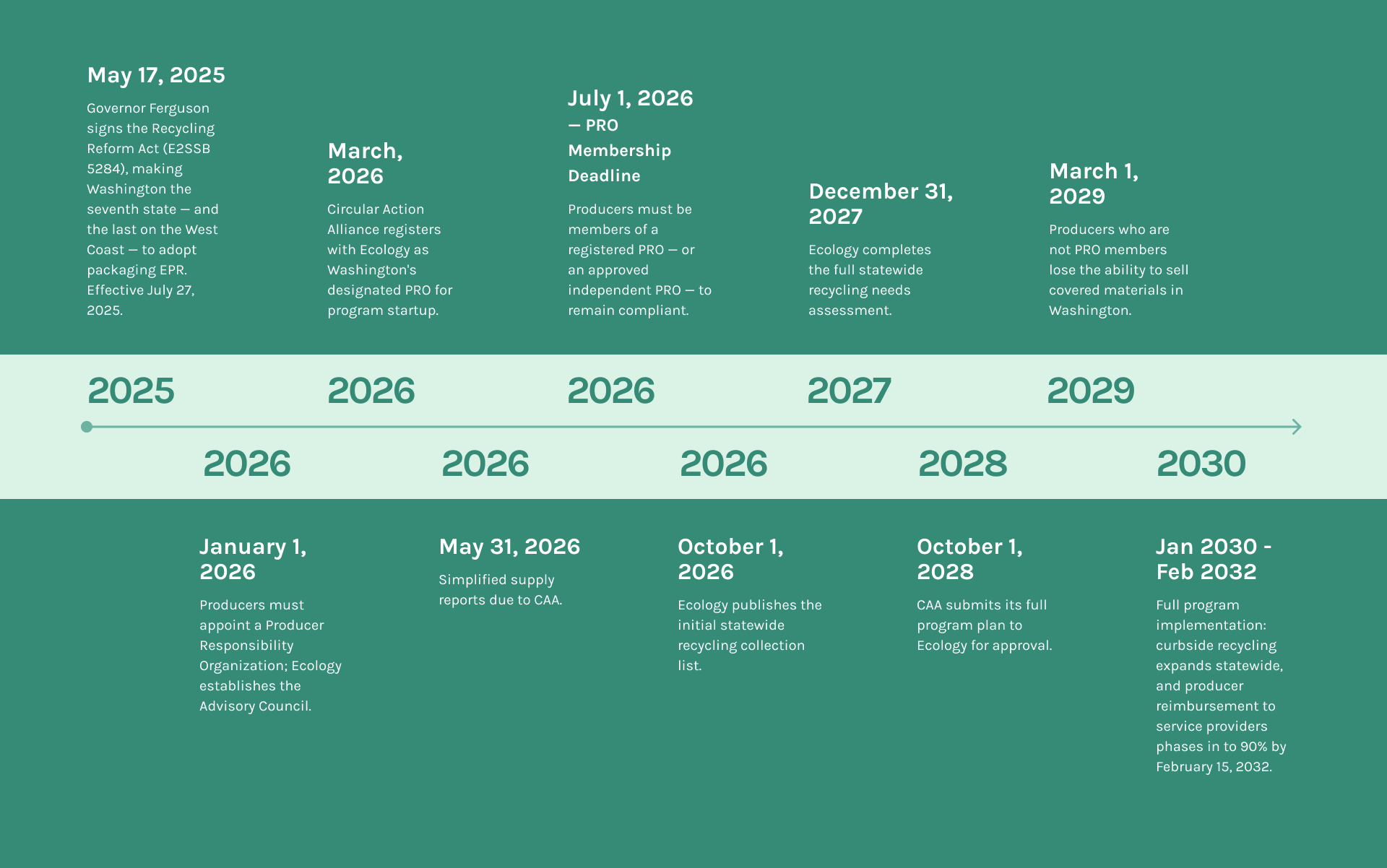
Washington’s Recycling Reform Act is still building toward full program launch in 2030, but the near-term compliance clock is already running. Producers were required to appoint a PRO by January 1, 2026, and to be a registered PRO member by July 1, 2026. If your business sells packaging or paper products into Washington and hasn’t appointed a PRO, that deadline is behind you, not ahead of you.
Important: Full fees, curbside expansion, and service-provider reimbursement don’t begin until the 2030 program launch. But registration and reporting obligations are active now — Circular Action Alliance has been Washington’s designated PRO since March 2026, and simplified supply reports were already due May 31, 2026. Waiting for 2030 to engage means starting from a compliance deficit.
2025
Year Washington’s Recycling Reform Act was signed into law
July 1, 2026
Deadline to be a registered PRO member
$5M /
1 ton
Small producer exemption thresholds
Circular Action Alliance
Washington’s designated PRO
$1,000–$10,000/day
Penalty range, first violation to repeat violations
What Is Washington's Recycling Reform Act?
Washington’s Recycling Reform Act (E2SSB 5284), signed by Governor Ferguson on May 17, 2025, makes producers — not local governments and residents — responsible for funding the recycling of the packaging and paper products they sell into the state. Washington was the seventh state to pass a packaging EPR law, and the move completed EPR coverage across the entire U.S. West Coast.
The law’s goal is straightforward: one statewide list of what’s actually recyclable, curbside recycling extended to hundreds of thousands more households, and producers picking up at least 90% of the system’s cost instead of taxpayers.
"Why it exists":
- Washington’s waste recovery rate has been essentially flat since 2011, and the state’s 50% recycling goal — set back in 1989 — was never met.
- The Act creates one statewide collection list, replacing a patchwork of city-by-city rules that left residents guessing what’s actually recyclable.
- Producer-funded reimbursement — phased to 90% of system costs by 2032 — takes that burden off local governments and ratepayers.
Why Paper Wins Under Washington's Recycling Reform Act
Washington’s law explicitly exempts materials that hit a 65% reuse or recycling rate for three consecutive years — a bar that rises to 70% in 2030. Most plastic packaging isn’t close. Paper is. Combine that with the law’s broader eco-modulation approach, where highly recyclable materials draw lower fees once the PRO fee schedule is set, and paper tubes are built for exactly the profile this law rewards — FSC certified, compostable, biodegradable.
This is not a footnote to your compliance math — it’s a real head start on Washington’s numbers. One tube at a time, we’re planting trees through our One Tree Planted partnership on top of it.
Are You a “Producer” Under Washington's EPR Law?
If your business makes, sells, imports, distributes, or licenses the brand on packaging or paper products sold into Washington, you may be a “covered producer” — even if you don’t manufacture the packaging yourself.
Covered materials include:
- Packaging — paper, plastic, metal, or glass materials that protect, contain, transport, or facilitate delivery of a consumer product sold for personal, noncommercial use — including primary, secondary, and tertiary packaging
- Paper products — most paper sold for personal use, though bound books, newspapers, copy paper, and construction paper are excluded
Who counts as the “producer”?
- The brand owner of the product sold in packaging in Washington
- If there’s no clear brand owner, the brand licensee, importer of record, or distributor
- Any other entity contractually designated as responsible
Who's exempt?
- Businesses with less than $5 million in global gross revenue OR under 1 ton of covered packaging sold into Washington per year
- Specific food and medical packaging, and hazardous materials packaging
- Materials with a demonstrated 65% reuse/recycling rate for three consecutive years (rising to 70% in 2030)
- Other exclusions include bound books, copy paper, some transport packaging, photovoltaic solar panels, light bulbs, and electronic products
If your business makes, sells, imports, distributes, or licenses the brand on packaging or paper products sold into Washington, you may be a “covered producer” — even if you don’t manufacture the packaging yourself.
Washington EPR Timeline: Key Dates and Milestones
What Producers Are Required to Do
- Appoint a Producer Responsibility Organization (PRO) — required since January 1, 2026
- Be a registered member of that PRO, or run an approved independent PRO — required since July 1, 2026
- Report quantities, material types, recyclability, toxicity, and reuse progress on packaging and paper sold into Washington
- Maintain detailed records and submit invoices for reimbursement where applicable
- Meet performance standards the PRO sets under Ecology's oversight, including future eco-modulated fee schedules
Penalties for non-compliance:
Civil penalties of up to $1,000 per violation per day, increasing to $10,000 per day for repeat violations, with additional penalties for continuing to sell noncompliant products after a warning. Washington’s Department of Ecology generally leads with education and technical assistance before enforcement, but monetary penalties are used when voluntary compliance doesn’t happen.
How Washington EPR Fees Work
Washington’s PRO is responsible for setting the actual producer fee schedule — expected to be refined through 2028’s program plan development and finalized ahead of the 2030 launch — using an eco-modulation structure where fees are lower for highly recyclable materials, the same core mechanism Oregon, Colorado, and California use.
- Materials with a demonstrated 65%+ reuse or recycling rate (70%+ starting 2030) can qualify for exemption entirely — this is where paper tubes are built to land
- Fees are expected to scale with volume, material type, and recyclability once the PRO fee schedule is set
- A one-time PRO payment to Ecology is due by September 1, 2026 to cover program costs through mid-2027; the PRO’s own annual registration fee is set every year starting March 31, 2027
Estimate Your Washington EPR Fees
Get a fast, ballpark estimate of your Washington EPR obligation based on your packaging volume, material mix, and revenue. This is an estimate to help you plan — final fees are determined by Circular Action Alliance once the program fee schedule is set.
FAQ SECTION
What is EPR in Washington?
Extended Producer Responsibility (EPR) is a policy that makes companies financially responsible for recycling the packaging and paper products they put on the market, rather than leaving those costs to local governments and residents.
Who has to comply with Washington's Recycling Reform Act?
Any business that makes, sells, imports, distributes, or owns the brand on packaging or paper products sold into Washington — unless it qualifies for the small-producer exemption (under $5 million in global revenue or under 1 ton of covered material into Washington per year) or another specific exclusion.
What is Circular Action Alliance?
Circular Action Alliance (CAA) is the nonprofit Producer Responsibility Organization Washington’s Department of Ecology confirmed in March 2026 to manage registration, fee collection, and reporting on behalf of producers who appoint it.
How much are Washington EPR fees?
What happens if I don't comply?
Non-compliance can mean civil penalties of $1,000 per violation per day, rising to $10,000 per day for repeat violations, plus the risk of losing the ability to sell into Washington entirely after March 2029 if you’re not a PRO member.
Does paper packaging cost less to comply with than plastic?
Generally, yes — and Washington’s law makes that especially explicit. Materials that hit a 65% recycling rate for three straight years (70% starting 2030) can be exempted outright, a bar most paper materials clear far more easily than plastic.
How is Washington's law different from Oregon's, California's, or Colorado's EPR laws?
Latest on Washington EPR

Who Does the Oregon EPR Injunction Actually Affect? (It’s Not Who You Think)
What Is “Mega May”? The 6-State EPR Reporting Deadline Every Brand Needs to Know.
Paper vs. Plastic: Why EPR Fees Are Up to 10x Higher for Plastic Packaging
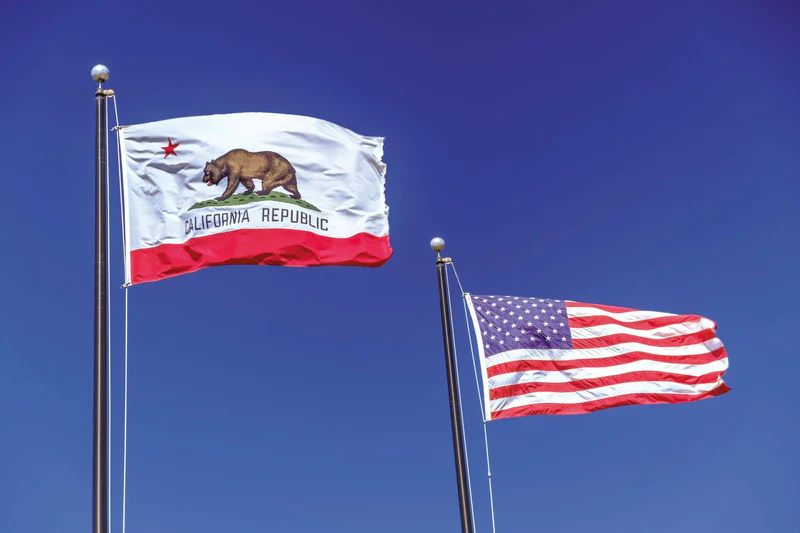
California SB 54 Is Now Law: What Brands Must Do Before June 1, 2026
Washington EPR Glossary
- EPR (Extended Producer Responsibility): A policy model requiring producers to fund the end-of-life management of the products/packaging they sell.
- PRO (Producer Responsibility Organization): A nonprofit that manages compliance, fee collection, and reporting on behalf of producers. CAA is Washington’s designated PRO.
- Covered Materials: Residential packaging and paper products subject to the Recycling Reform Act, spanning paper, plastic, metal, and glass.
- Producer: The entity legally responsible for compliance — typically the brand owner, brand licensee, importer of record, or distributor.
- Eco-Modulation: Fee adjustments based on a product’s environmental impact — lower fees, or outright exemption, for highly recyclable materials.
- Advisory Council: A 17-member body appointed by Ecology, including tribes, retailers, recyclers, producers, and local governments, that reviews PRO activities and advises on implementation.
- Statewide Collection List: Washington’s single list of materials accepted for curbside recycling statewide, due from Ecology by October 1, 2026, replacing city-by-city rules.
Need Help With Washington EPR Compliance?
Packaging that Gets Noticed. Eco-friendly. Finely crafted. For global brands and local artisans — and now, built for what Washington requires.
This page is provided for general informational purposes and reflects publicly available information as of August 2026. It is not legal advice. Washington’s Recycling Reform Act is still in early implementation, and fee schedules, collection lists, and exemption details are subject to change as Ecology completes rulemaking — consult the Washington Department of Ecology, Circular Action Alliance, or your legal counsel for guidance specific to your business.
Sourced from the Washington Department of Ecology, Circular Action Alliance guidance, and current legal/industry coverage of E2SSB 5284 as of August 2026. Recommend legal review before publishing, particularly the fee and penalty figures, which are still being finalized.